Should You Hold Or Sell Your Sherman Acreage?
June 11, 2026

June 11, 2026
If you own acreage in Sherman, you may be asking the right question at exactly the right time: should you hold, make improvements, or sell? With Sherman growing fast, major employers expanding, and infrastructure work moving forward, landowners have real opportunity, but not every tract should be handled the same way. This guide will help you think through the decision with a practical lens so you can weigh timing, costs, and marketability with more confidence. Let’s dive in.
Sherman is seeing measurable growth. The U.S. Census Bureau estimated the city’s population at 52,417 as of July 1, 2025, which is a 20.0% increase from the 2020 base. That kind of growth matters because it can influence land demand, development pressure, and buyer interest over time.
The city is also investing in infrastructure to support that growth. Sherman’s 2025-2026 budget includes about $187.2 million in appropriations, along with road work such as extensions to Moore Street, Lamberth Road, and Friendship Road. The city’s infrastructure program says roadway, drainage, water, and wastewater improvements are being built to support the growth already taking place.
Large employers are adding to the story. Texas Instruments says its Sherman site has SM1 in production, is planned for up to four connected fabs, and represents a potential $40 billion investment with 3,000 TI jobs plus thousands of indirect jobs. The city also says GlobalWafers America will be in Sherman, which adds more weight to the area’s growth outlook.
The broader land market in Northeast Texas remains active, but it is not a one-size-fits-all market. The Texas Real Estate Research Center’s First Quarter 2026 Northeast Texas report, which includes Grayson County, shows price per acre at $8,960, up 0.98% year over year. Annualized sales volume rose 1.32% to 844 transactions, and total acreage rose 8% to 28,658 acres.
At the same time, the market appears selective. The report notes that pricing was sustained by the 34-53 acre segment, while larger tracts declined year over year. In plain terms, that can mean smaller or more build-ready tracts may be easier to market than large raw acreage that still carries unanswered questions.
That distinction matters if you are deciding whether to hold, improve, or sell. Your acreage count is important, but buyers also look closely at how usable and understandable the tract is on paper. A property that feels straightforward often attracts stronger interest than one that leaves too much uncertainty.
One of the first questions buyers ask is whether the tract has clear legal access. In unincorporated Grayson County, if a property uses an access easement instead of frontage on a county-maintained road, the county says recorded documentation must be presented to request an E-911 address. That means physical entry alone is not the same as clearly documented access.
If your tract fronts a state highway, driveway access can bring another layer of review. TxDOT requires driveway permits for driveways on the state highway system, and its access-management rules encourage shared access driveways when adjoining owners combine frontage. For a buyer, that can affect both planning and cost.
Utility certainty can have a big effect on how quickly a tract makes sense to a buyer. Inside Sherman city limits, the utility department provides combined monthly billing for water, sewer, and trash, and the city says it provides curbside trash service and free drop-off recycling. Outside city limits, the path may look different, and septic feasibility becomes especially important.
In Grayson County, a new or replacement septic system requires an OSSF permit. The Texas Commission on Environmental Quality says the site must be evaluated by a licensed site evaluator or professional engineer before an OSSF is constructed, installed, altered, extended, or repaired. If you already know the septic path, that can remove a major buyer question.
A tract can lose momentum fast if the paperwork is unclear. Grayson County says a plat is required each time a legal boundary changes, and county plats need Commissioners Court approval before filing. If the tract is inside city limits, city plats need city council approval.
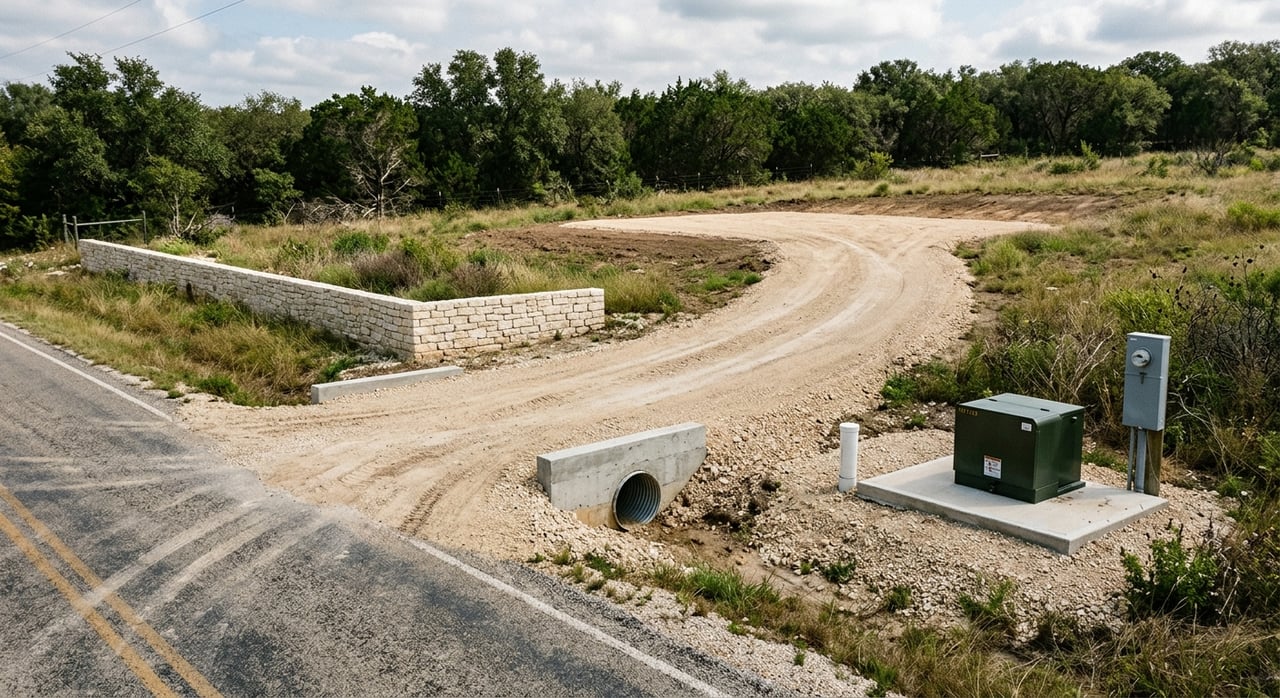
The county also requires a Development Certificate for new E-911 addresses, new culvert installations, and floodplain determinations. Those are not small details. They are often part of what makes a tract feel ready, or not ready, for a buyer’s intended use.
Unincorporated Grayson County has no zoning outside the Lake Ray Roberts and North Texas Regional Airport zoning districts. Even so, subdivision must still follow county subdivision regulations, and deed restrictions or HOA rules may still apply. That is why landowners should not assume flexibility without checking the tract’s specific records and status.
Holding can be a smart choice if your land already serves its purpose well and you do not want to take on improvement costs right now. This can be especially true if the tract has legal access, workable agricultural use, and no urgent reason to force a sale. In a growing market, patience can be part of the strategy.
Holding may also deserve a closer look if your property benefits from agricultural appraisal. Grayson CAD says agricultural appraisal requires active agricultural use and generally five of the preceding seven years. It also notes that a change of use or platting into a subdivision can trigger rollback tax consequences.
That does not mean you should never sell or improve. It simply means the timing of your decision may carry consequences beyond list price alone. If your land is functioning well today, preserving flexibility while Sherman continues to grow could be a reasonable path.
Improving acreage does not always mean major construction. In many cases, the most valuable improvements are the ones that remove uncertainty for a future buyer. That can make the property easier to underwrite, easier to record, and easier to market.
A practical improvement strategy may include:
These steps can help turn a confusing raw tract into a tract buyers can quickly understand. In a selective market, clarity can be a major advantage.
Selling may make the most sense when your property is already well positioned for current demand or when the cost to improve it would be too high to justify. If major road work, utility work, or subdivision preparation would be needed before the tract becomes more marketable, you may decide it is better to sell based on today’s value and let the next owner take on that work.
Sherman’s current backdrop gives sellers a real story to tell. Population growth, major manufacturing investment, and ongoing infrastructure work all point to a market that is active rather than stagnant. That does not guarantee every tract will command the same response, but it does support the idea that well-presented acreage can attract serious attention.
If you sell, specifics matter. Buyers are likely to focus on acreage count, road access, utility path, agricultural status, and whether the tract can be split. The clearer you are on those points, the easier it is for buyers to evaluate the opportunity.
Start by looking at your tract through a buyer’s eyes. Would they clearly understand how to access it, whether it can support septic, and what would be required to divide or improve it? If the answer is no, that may point toward selective improvements before going to market.
If the tract is already clean and well-documented, selling now may be easier to justify. If the property works well as-is and you want to stay flexible, holding may be the better fit.
Your decision is not just about the market. It is also about how much time, money, and effort you want to invest. Some owners would rather avoid engineering, permitting, surveys, or platting and prefer to sell the tract in its current condition.
Others are willing to do a few targeted steps to improve marketability. The right answer depends on your goals, not just on headlines about growth.
The current land data suggests buyers may be more responsive to certain tract profiles than others. With the 34-53 acre segment helping sustain price while larger tracts declined year over year, readiness and size may affect demand. If you own a larger raw tract, packaging the property with clear documentation may be especially important.
If you decide to sell, a strong listing file can help reduce hesitation and support cleaner conversations with buyers. Around Sherman, the best land files usually answer four core questions quickly: can it be built on, can it be legally accessed, can it be served by utilities or septic, and can it be divided or reconfigured without a surprise?
Helpful listing materials may include:
This is where practical land experience matters. A well-prepared acreage listing is not just about putting a sign up. It is about presenting the tract in a way that helps buyers understand risk, cost, and opportunity from the start.
If you are weighing whether to hold, improve, or sell your Sherman acreage, the best next step is usually a tract-specific review. The details that shape value are often the same details that shape buyer confidence. For experienced guidance grounded in real land knowledge, reach out to Lesli Ray Etzel.
Stay up to date on the latest real estate trends.
July 23, 2026

July 16, 2026

July 9, 2026
July 2, 2026

June 25, 2026
June 18, 2026
June 11, 2026
June 4, 2026
May 28, 2026
Through her extensive experience, passion and skills in understanding and explaining the purchase or listing transaction, her negotiating skills and ability to stay calm and focused under pressure has proven to be invaluable.